Sunday, February 04, 2007
Organicity —
For many years, I rarely ate apples. They simply didn't taste good to me. It was only in the last couple of years that I began eating apples more frequently, and I no longer have an aversion to them. What changed? I never really thought about that question, and definitely didn't have an answer, until Brian's mother lent me the Organic Cook's Bible, by Jeff Cox.
In the opening lines of the book, Cox describes the best apple he ever tasted. It was a blackish red, somewhat rare variety of apple that he bought at a small market. Cox goes on to discuss the only apple variety most of us are familiar with:The proliferation of the inferior Red Delicious is due to two primary marketing factors. First, the apples have deep red skins and consumer preference tests show that people associate a deep red apple with quality, even if, as with Red Delicious, there's precious little quality to the flavor. Second, they are called "delicious" even though they aren't.
As I read those lines, it dawned on me that for all these years, I had been avoiding not apples, but a single variety of apple, the variety which is usually the only one you can get. Then two years ago I moved next door to a Whole Foods, which has much more to offer than Red Delicious, and organic too. Thus my re-acquaintance with apples.
Here's a photo, by the way, of the type of apple that Cox had. Alas for "consumer preferences".
This story is not limited to apples. The food industry, like some Plato scared of variety, has long been on a quest to reduce food to these limited ideals. Red Delicious is "the" apple (or maybe Granny Smith). Black Beauty is "the" eggplant. White Button is "the" mushroom. And on throughout the food supply:Scientists have recorded over 15,000 plants that have been used by human beings as food over the millennia, but there are only about 150 commercially important food crops worldwide these days. And in the large corporate food systems that provide foods to our supermarkets and big commercial stores, only a few of these 150 commodities are typically available to the consumer.
And as is the case with apples, the chosen variety is frequently the inferior one. Cox, former editor of Organic Gardening, introduces us to the other varieties of vegetables, fruits, nuts and grains throughout the book, and while perusing his in-depth descriptions, I was struck by how little I know about the food I eat.
For instance, there is a variety of eggplant that actually looks like a white egg. Avocado flowers are the only flowers which change their sex. Black canned olives are actually green unripe olives soaked in lye. Pineapple juice can eat your skin. These are some of the more odd and intriguing facts among all the information about varieties, seasons, growing tips, and best regions to grow what—knowledge that has been lost in our age of standardized food available year round. Quick: what type of food grows best in the area you live in?
I don't know either, but this book makes me want to find out.Over centuries and sometimes millennia, local people had learned which crops and types of livestock thrived in their climate and on their soils. ...Cooking techniques and recipes were for centuries very region-specific, and over time cooks in those areas learned how to make the most palatable dishes from unique local products. ...The French call these site-specific flavors terroir, or soil, which is a succinct way to describe the phenomenon that each specific place on the earth will express itself in the taste of the food that grows there.
The food industry has been steadily trying to destroy terroir with inferior-tasting food, an arsenal of chemicals, and genetic-engineering. Terroir is the opposite of what most corporations are all about: standardization and monotony, also known as branding. That you can go from Beijing to Bangalore to Paris to New York, and in each place get Big Macs and Frappuccinos, is the corporate, anti-terroir wet dream.
Although the major food corporations have tried and will continue trying to water down organic food rules, it looks like the tide is turning somewhat with the growth of of the organic food movement in recent years. Cox has been involved in this movement since the beginning (in America), and the book is interspersed with 250 wonderful recipes that he's collected over the years, and with stories of the unique, delicious, and local food he's encountered in his travels across the country. Reading this book makes you hungry, but with a different sort of hunger. You want to stop at a rural fruit stand, you want to pick something in the wild, to find food at the right time and the right place—and savor those lucky moments which you can't get with conventional food. If you care about the environment and the food you eat, this book is definitely worth buying.
I must end with one last fact, this one about rabbits:Buck rabbits are either screamers or fainters. That is, after they mate with a doe, they either scream or faint. Just a point of interest.
Some relevant links:
http://www.slowfoodusa.org/
http://www.oldwayspt.org/
http://www.treesofantiquity.com/
http://www.localharvest.org/
http://www.gourmetsleuths.com/
filed under: corporate US, food
Sunday, November 19, 2006
Wo Er Ma —
This month-old article about Wal-Mart bidding for the Chinese chain Trust-Mart brought back memories of my time in Wuhan. (I actually started this post a month ago, then partly because of this post, I got side-tracked with integrating Google Maps with my blog to show various places from my travels—took me quite a while. You can see the result in the "places I've been" link on the right. ) Right behind my school there was a Trust-Mart, and it's where I did nearly all of my shopping for a year. Its Chinese name is 好又多, which means something like "good (things) and many (things)." (Wal-Mart's name in Chinese is 沃尔玛 — it has no meaning really, but rather is phonetic. You can see the literal meaning of each character here.) But I didn't find it that great, and once I discovered some of the other, better supermarkets—Carrefour (家乐福), Fu-Mart (大福源), and even, I'm ashamed to admit, the Wal-Mart which opened up in 2004—I rarely went back. (There was also the much smaller but more spread-out Zhongbai (中百), a branch of which opened directly below my school in 2002.)
Though they might vary in cleanliness and selection, the layout of all the large supermarkets was the same, and I suspect it's so throughout China: They are all housed in a large 2- or 3-story building that looks more like a department store from the outside. When you walk through the entrance, you see several stalls and small shops where people sell clocks, shoes, jewelry, tea, and trinkets. Most likely, there is a canteen nearby. You cannot enter the store itself from the first level. You have to take an escalator to the second or third level, where you may encounter some other stalls before you can actually enter the store proper. Upstairs they sell about every non-edible item you might want in your home in China: TVs, radios, dumpling steamers, office supplies, water heaters, mosquito nets, washing machines, rice cookers, clothes, shoes, dishes, woks, bicycles, weights, toys, mahjong (麻将), toiletries, electric fly-swatters, calligraphy paper, Hello Kitty crap, karaoke machines, dictionaries, pirated CDs and DVDs...
You have to wind your way through all of this stuff—this is China's version of putting the milk and bread in the back—which can be incredibly difficult if you're pushing a cart through weekend crowds. Then finally you get to the escalator going down, and you descend into the smells of food.
At Fu-Mart, you gently sank into the wonderful smell of baking bread, but most other places brought you down right in the fish and meat section, where the smells of preserved salty fish, flattened dehydrated chickens, frogs and eels in aquariums, and all sorts of animal parts, rushed into your nostrils like Henry V's army unto the breach.
As you might have guessed from the brief list of 2nd-floor items I recounted above, there are all sorts of odd things you can find in Chinese supermarkets, and this becomes even more apparent as you wander amongst the food.
Dried shredded fish. Black herbal jello. Geriatric nut powders. Dried string mushrooms. Frozen fish balls. Tree ear fungus (木耳). Tofu that looks like dried corn husks. Spicy pickled vegetables. Curdled pig blood. Lotus seeds. Blackened preserved eggs (皮蛋). Sesame paste. Plum sauce. Red bean paste (红豆沙). All the wonderful Chinese vegetables, such as caitai (菜苔), uncommon outside of Hubei Province, and lihao (蓠蒿). Chinese fruit, like longyan (龙眼) and lizhi (荔枝). Noodles for local dishes such as hot-dry noodles (热干面) and cold noodles (凉面), as well as all sorts of other noodles. Endless varieties of tea. (And that's just what I can remember from a single sitting.)
Then after you check out (without the benefit of conveyor belts like in the US), you had to get your receipt stamped before going out the narrow exit (like the pass of Thermopylae) and back amongst the vendors. Then you did like everyone else does, and which I still do here, living as I do close to a supermarket—you park your cart, heft up your bags, and walk home. If it was raining, you might have caught a taxi or, before they were banned in 2003, a mamu (麻木 - a local Wuhan name for tricycle pedicabs).
All of these wonderful items—sometimes more, sometimes less—were available in the traditional outdoor street markets, which are great places to walk around in, and look at people and things. I didn't shop too often in the markets because, especially as a foreigner, I could never be sure I was getting a fair price. You have to haggle and bargain in the markets, and my general aversion to bargaining coupled with my inability to do so in Chinese guaranteed I would never get the price I could get in the supermarkets.
Yet it would be a shame if the outdoor markets disappeared. I wonder if the emergence of these supermarkets in recent years signals the beginning of the end, and the eventual lessening of variety, especially now that Wal-Mart is on the scene.
Admittedly, the Wal-Mart in Wuhan was much nicer, not to mention bigger, than any Wal-Mart I've seen in the U.S. The building it's in is actually rather stylish, and sells some things you'll never see at a Wal-Mart here. (Actually, those aren't porn videos, but sex education videos with very titillating covers and very boring content.)
So I didn't really feel it that bad or tasteless to shop there, like I do in America, though I went as little as necessary, preferring Fu-Mart above all others.
But I think it's only a matter of time—perhaps a long time given the size of the country and it's population, but witness the rapidity with which McDonald's and KFC have spread their tentacles throughout China (770 and 1,700 locations by November 2006, respectively - source). Once the outdoor markets go, then the variety in supermarkets themselves will begin to shrink. And when it's all over I wonder how much of the weird and wonderful and local variety will be lost, and replaced by a generic cuisine you can find any old place. Just like in the U.S.now that Mal-Wart has opened its doors in China, and is acquiring a Chinese chain as well, is the diversity of the country's food and other products endangered?
filed under: China, corporate US
Sunday, October 08, 2006
Better Coffee —
I had rarely for many years used animal food, or tea, or coffee, &c.; not so much because of any ill effects which I had traced to them, as because they were not agreeable to my imagination. ... think of dashing the hopes of a morning with a cup of warm coffee, or of an evening with a dish of tea!
When I came across those lines in Walden, my reverence for Thoreau slipped, not quite a notch, but a few hairs at least. I love coffee. I look forward to the brew almost every afternoon. (I've never really been one to cry for a cup in the morning.)
I enjoy the ritual of making it, the anticipation while it cools just a little, and the hot dark taste as it goes down—not to mention the caffeine fix. That's what got me through the all-nighters I pulled in high school (and one double all-nighter) and college, though the boost I get is milder now.
The passage in which the above quote occurs discusses our animal life vis a vis our spiritual. Thoreau doesn't elaborate much here on his aversion to coffee, instead deliberating on the virtues of abstaining from meat, but it seems to stem from a concern with being enslaved to exotic appetites and addictions at the expense of higher pursuits. Later on he gets more economic:I did not use tea, nor coffee, nor butter, nor milk, nor fresh meat, and so did not have to work to get them; again, as I did not work hard, I did not have to eat hard, and it cost me but a trifle for my food.
This is not an issue with coffee anymore (except for those who drop $4+ at Starbucks everyday), though there are plenty of contemporary addictions this could be applied to—cars and oil spring to mind, as do disposable AA batteries for all of our portable electronic gadgets.
But I think Thoreau would have plenty more to say about coffee were he around today. I think he would criticize the mass production of inferior coffee products, the exploitation of the environment and people of coffee-producing countries, and our reduction of coffee to the merest utilitarian purpose of giving us a little more energy to work.
I was made aware of all of this and much more when I read Uncommon Grounds by Mark Pendergrast. I left the book at my school in China for the enlightenment of any coffee drinkers who might come that way, otherwise I'd quote from it.
But Pendergrast traces the history of coffee from the legend of Kaldi's dancing goats to the Starbuck's phenomenon of our time, and I highly recommend his book. He particularly focuses on the late 19th and 20th centuries, explaining the increasing intertwining of coffee with international relations, economics, and our domestic lives, as well as discussing how coffee was produced, packaged and sold over the years, and how that influenced the quality and taste of the coffee we drink.
Two things become apparent when reading this book:
Because of this, most of the coffee out there is no good, and most people don't really know what a good cup of coffee tastes like—and yet the big coffee companies rake in money every year.
Consider your canned coffee. Generally made from the cheaper, poorer-tasting Robusto beans, grown with pesticides and paid pennies for. Pre-ground long before it's brewed, so it rapidly loses flavor. And old after sitting on the shelf at the store and at home for weeks and weeks, possibly months or even longer. Coffee is a perishable commodity and needs to be brewed as soon after roasting and grinding as possible.
When I read this book, I had been regularly drinking Nescafe Gold instant coffee, as that was the easiest type of coffee to buy in China. After I finished, though, I vowed never to drink instant coffee again, or crappy regular coffee, even if nothing else were available (that's the only way to fight the "increase quantity, decrease quality" corporations). Generally I have succeeded—I can count on one hand the number of times since then I've had crappy coffee with a couple of fingers left over.
I also decided to seek out a better way to make coffee. The book mentioned the French press method as the best, but I never liked the grit that always gets through the filter mesh. I'd used drip coffee makers all my coffee-drinking life, but I knew I'd never had a truly excellent cup from one of those. But aside from a drip, the options available to me in China were nil (although I always saw these cool vacuum pots and other contraptions in the numerous cafés there).
I ended up rigging up something with clothes pins, a large glass jar, and some coffee filters I managed to find. It worked, and not too badly, but though the coffee I used was better than Nescafe Gold, it was not quite the taste I was looking for. (I bought it pre-ground at the French supermarket chain, Carrefour—whole beans, and grinders for them, were impossible to come by—but at least it was real.)
After I came back to America, my quest for a better coffee-brewing method was superseded by the job search and everything else needed to get on my own two feet here. I did get some good beans, though. I tried some organic, shade-grown Green Mountain coffee, as well as Whole Foods' organic store-brand coffee. Now I get Whole Foods' Allegro coffee since they get a newly-roasted batch of beans every week, and you can buy whatever amount you like—I like to get about a week's worth at a time.
But until recently I was still using a drip coffee maker, though the particular model I had was a step up from what I had used in the past. I was still not getting the brew I wanted, and I attribute this to two things: the inside pot of this particular model being difficult to access and hence difficult to clean, and the plastic filter basket.
Coffee always leaves a residue, and just rinsing with water, soap and water, or even coffee pot cleaners does not remove the residue. It has to be physically wiped off. (This is why work coffee is so bad—those huge thermal servers have years of crud inside them, and cannot be cleaned.) Filter baskets are hard to clean effectively what with all the ridges. Furthermore, plastic seems to absorb coffee odors very easily, and it's nearly impossible to remove them. If you use a drip, smell the filter basket and you'll see what I mean (or let me know what soap you use). These old odors get into your coffee every time you brew.
After things settled down in the other areas of my life, I renewed my quest, and decided to give the French press another try, but with a paper basket filter to keep all the grit out. I read somewhere online that this could not be done without the filter shredding, but lo and behold it works, and works very well.
The French press I have was a mere $14 at IKEA, and has no plastic parts (except the handle and plunger knob). It also meets my other requirement of it being easy to clean all surfaces that coffee comes into contact with. And 8-10 cup filters fit perfectly in the glass beaker.
After the water (just below boiling) is poured over the grinds, I place the filter in the beaker mouth, press it down a little with the plunger, and fold the rest of the filter out over the edge so I can push the lid down.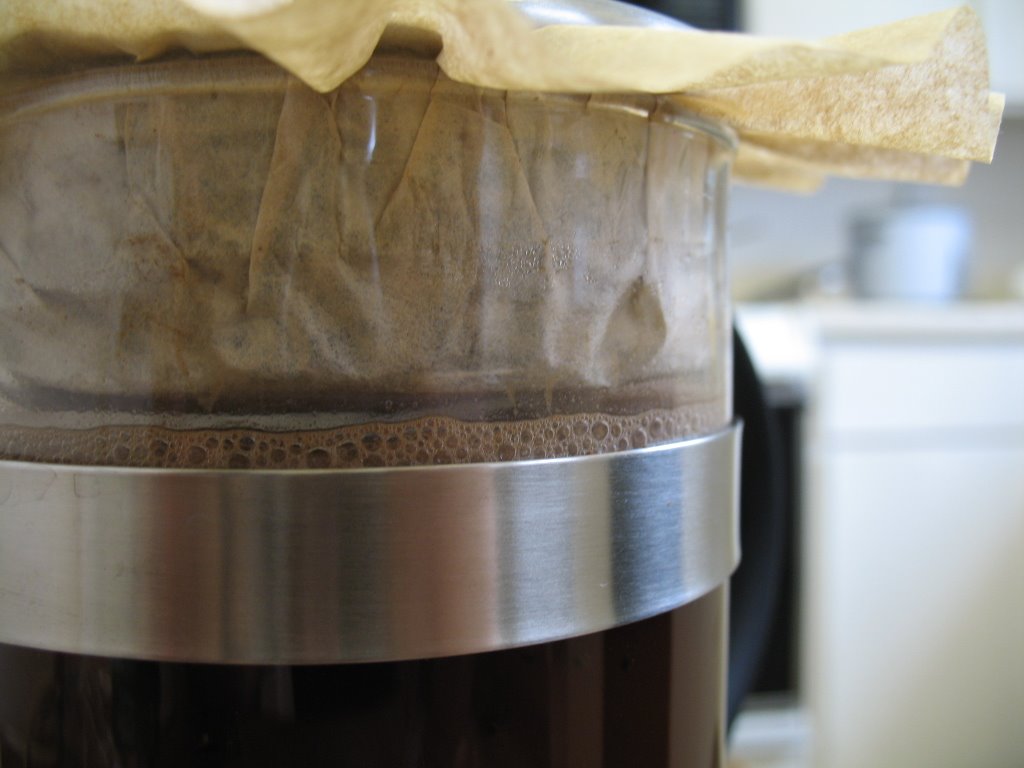
After 2-3 minutes (that's all the time you need) I lift the lid, fold the filter in, and slowly push down, pausing every 20 seconds or so to shake the press a little to scatter the grinds and allow for the easier flow of liquid through the filter. Pushing down too hard or quickly will cause the filter to tear.
I finish with a beaker full of excellent coffee, and pour it out so it doesn't brew further, and enjoy.
The only other thing I would like to get is a manual burr grinder to replace my electric blade whacker. The best burr grinders are made by Zassenhaus in Germany, but they've not exported any grinders to the US for about two years or so, hence they're hard to come by. I've been watching eBay, but every time a decent one is offered, the price ratchets up to $100+. Don't want one that badly. I've heard that blade whackers cause some flavor loss due to heat, but I just want to switch so I can get one less electronic gadget in my life.
Once I get there, I think I could brew some cups that even Thoreau might try, and hopefully he wouldn't exclaim afterwards, as he did in Walden, "Ah, how low I fall when I am tempted by them!"Bad coffee and how it got that way, and how to make it better.
filed under: corporate US, do it differently

