Sunday, May 13, 2007
Shave Away —
Several weeks ago after shelling out another $10.00 for four Gillette Mach 3 blades, I thought to myself, is it really this expensive to get a good shave? With the ridiculous evolution from the Gillette Sensor to the Mach 3 to the Schick Quattro to the Gillette Fusion, blade prices are going to keep ratcheting up. Just wait till this one comes along:
And, I wondered, is it really a good shave? "The best a man can get"? With all the masculine names and the dark, futuristic shapes and colors (the corporate-sponsored coolness), it's obvious the marketing department, at Gillette at least, is having a field day. But are these additional blades and whatnot really technological improvements for the whisker-growing half of humankind? The only noticeable difference for me between the Sensor and the Mach 3—I switched because the latter was given to me as a present—was the ease of cleaning the razor. Besides, men have been shaving for quite some time. Surely good shaves were had by many in my grandfather's day, and even earlier.
I also began thinking about the environmental impact. All that plastic which holds the cartridges, and then the plastic in the cartridge itself which holds the blades... Think about how much per man per year that is, all tossed into ever-growing landfills to rot and poison the land for 10,000 years. So I set out to see what alternatives I could find.
Initially I was thinking of getting a straight razor (I recall some family legends about my great-grandfather using one with nothing but Jergens lotion, and having a baby-smooth face), but after some research that seemed a little daunting what with all the sharpening and honing and stropping you have to do on a regular basis.
Then I came across this article. Except for the few glorious weeks following my first sprouting of facial hair, shaving has been a chore that I'd much rather avoid—hence I've had many a scraggly day. This article, however, made me want to spend the better part of my life under the blade.
The author, Corey Greenberg, who also has a blog on shaving, doesn't go all the way back to the straight razor, but extols the virtues of the double-edged safety razor. King C. Gillette started the Gillette company to manufacture double-edged safety razors back in 1901. Although safety razors had been around for a while, Mr. Gillette improved the design and came up with the concept of inexpensive disposable blades made of thin steel. He received a patent for his razor in 1904, and by the time World War I broke out he'd sold millions of razors and blades.
According to Greenberg, Gillette has pretty much gone downhill, shaving-wise, since then. Read the article for all the specifics and how-tos, but his main point is that a safety razor, together with a badger-hair shaving brush, good European-style shaving cream (not the testosteronic crap Gillette sells), and plenty of warm water provide a superb shave. Moreover, double-edged blades go from $.25 to $.50 each, and don't come with much plastic packaging, if any.
I checked various sites, like Classic Shaving, but delayed purchasing because I was worried it wouldn't really be a better shave. I did, however, find a tube of Italian Proraso shaving cream, which Greenberg praises, at Target for a very reasonable $5. It was a marked improvement over what I had been using—a lather of Dove body soap—and has a refreshing smell.
Then on a recent trip home, I discovered that my Mom had—among all her other antiques, trinkets, and bric-a-brac—a 1950's era Gillette double-edged safety razor in good condition, and a shaving brush sitting decoratively on the bathroom shelf. I promptly snatched them—of course, I asked my mother first—and brought them home.
I'm not sure what the brush is made of, but my guess would be badger hair. My mother also had one of those boar's hair brushes that you can easily find in supermarkets, and it was much stiffer and coarser (read: scratchier on your face).
Now the only thing I needed was blades. I found a place online that offered 100 for $25, but I was still a little hesitant, and wanted to give this razor a try without getting stuck with a box of 99 blades in my bathroom cabinet. So I ended up buying 10 from CVS for $5 (unfortunately it had some plastic casing).
That night I eagerly lathered up and tried it all out. It worked pretty well, much better than I was expecting, although it took quite a bit longer to shave as I was being extra careful not to nick myself. The blade is more exposed on a safety razor, and I knew if I pressed it against my face and carelessly scraped it around like I can my Mach 3, I'd be a bloody mess. (I did get a few nicks though when by habit I pressed down too hard.) Consequently, I didn't get quite the smoothness I wanted, but I figured it just takes a bit of practice.
The next time I tried it (I usually shave every other day), it was much the same, and then the third time I annoyingly got quite a few more nicks. It takes a little while to get the art of it, I guess. When again it was time to shave, I put in a fresh blade and tried to get into a zen state of relaxation. I also left my glasses off so I could go more by feeling and intuition than what my eyes would tell me to do, and I ended up with the best safety razor shave I had yet.
Since then, my technique has steadily gotten better, although I occasionally get a few more nicks than I like (usually when the blade starts getting dull). I thought my Cape Horn of a chin would be the most difficult part to shave, but it's not presented any problems. Rather my neck, particularly the lower part that's almost level with my Adam's apple, is, if you will, the Achilles' heel of my shave. My beard is especially thick here, and grows in two different directions. It's trickier to handle these with a safety razor.
Also, it still doesn't seem to be quite as close a shave as I've gotten with the Mach 3, but that's slowly improving as well. Overall, however, it's an improvement. My skin does not get as irritated as it used to, and it doesn't bother me to shave two days in a row now. I like the ritual of building a good lather, brushing it on my face, and then with a light touch whisking away my whiskers, all the while inhaling the aroma of the shaving cream—it's no longer such a chore.
I would toss my Mach 3, but I'll probably need it whenever I fly. I can't imagine a safety-razor with its completely detachable blade being allowed past security, even in the pre-9/11 era. So this'll be another one of those things that inspire me to sing along with Sinatra:It's nice to go traveling
To London, Paris and Rome.
It's oh so nice to go traveling,
But it's so much nicer,
Yes it's so much nicer
To wander home.
filed under: do it differently
Sunday, October 08, 2006
Better Coffee —
I had rarely for many years used animal food, or tea, or coffee, &c.; not so much because of any ill effects which I had traced to them, as because they were not agreeable to my imagination. ... think of dashing the hopes of a morning with a cup of warm coffee, or of an evening with a dish of tea!
When I came across those lines in Walden, my reverence for Thoreau slipped, not quite a notch, but a few hairs at least. I love coffee. I look forward to the brew almost every afternoon. (I've never really been one to cry for a cup in the morning.)
I enjoy the ritual of making it, the anticipation while it cools just a little, and the hot dark taste as it goes down—not to mention the caffeine fix. That's what got me through the all-nighters I pulled in high school (and one double all-nighter) and college, though the boost I get is milder now.
The passage in which the above quote occurs discusses our animal life vis a vis our spiritual. Thoreau doesn't elaborate much here on his aversion to coffee, instead deliberating on the virtues of abstaining from meat, but it seems to stem from a concern with being enslaved to exotic appetites and addictions at the expense of higher pursuits. Later on he gets more economic:I did not use tea, nor coffee, nor butter, nor milk, nor fresh meat, and so did not have to work to get them; again, as I did not work hard, I did not have to eat hard, and it cost me but a trifle for my food.
This is not an issue with coffee anymore (except for those who drop $4+ at Starbucks everyday), though there are plenty of contemporary addictions this could be applied to—cars and oil spring to mind, as do disposable AA batteries for all of our portable electronic gadgets.
But I think Thoreau would have plenty more to say about coffee were he around today. I think he would criticize the mass production of inferior coffee products, the exploitation of the environment and people of coffee-producing countries, and our reduction of coffee to the merest utilitarian purpose of giving us a little more energy to work.
I was made aware of all of this and much more when I read Uncommon Grounds by Mark Pendergrast. I left the book at my school in China for the enlightenment of any coffee drinkers who might come that way, otherwise I'd quote from it.
But Pendergrast traces the history of coffee from the legend of Kaldi's dancing goats to the Starbuck's phenomenon of our time, and I highly recommend his book. He particularly focuses on the late 19th and 20th centuries, explaining the increasing intertwining of coffee with international relations, economics, and our domestic lives, as well as discussing how coffee was produced, packaged and sold over the years, and how that influenced the quality and taste of the coffee we drink.
Two things become apparent when reading this book:
Because of this, most of the coffee out there is no good, and most people don't really know what a good cup of coffee tastes like—and yet the big coffee companies rake in money every year.
Consider your canned coffee. Generally made from the cheaper, poorer-tasting Robusto beans, grown with pesticides and paid pennies for. Pre-ground long before it's brewed, so it rapidly loses flavor. And old after sitting on the shelf at the store and at home for weeks and weeks, possibly months or even longer. Coffee is a perishable commodity and needs to be brewed as soon after roasting and grinding as possible.
When I read this book, I had been regularly drinking Nescafe Gold instant coffee, as that was the easiest type of coffee to buy in China. After I finished, though, I vowed never to drink instant coffee again, or crappy regular coffee, even if nothing else were available (that's the only way to fight the "increase quantity, decrease quality" corporations). Generally I have succeeded—I can count on one hand the number of times since then I've had crappy coffee with a couple of fingers left over.
I also decided to seek out a better way to make coffee. The book mentioned the French press method as the best, but I never liked the grit that always gets through the filter mesh. I'd used drip coffee makers all my coffee-drinking life, but I knew I'd never had a truly excellent cup from one of those. But aside from a drip, the options available to me in China were nil (although I always saw these cool vacuum pots and other contraptions in the numerous cafés there).
I ended up rigging up something with clothes pins, a large glass jar, and some coffee filters I managed to find. It worked, and not too badly, but though the coffee I used was better than Nescafe Gold, it was not quite the taste I was looking for. (I bought it pre-ground at the French supermarket chain, Carrefour—whole beans, and grinders for them, were impossible to come by—but at least it was real.)
After I came back to America, my quest for a better coffee-brewing method was superseded by the job search and everything else needed to get on my own two feet here. I did get some good beans, though. I tried some organic, shade-grown Green Mountain coffee, as well as Whole Foods' organic store-brand coffee. Now I get Whole Foods' Allegro coffee since they get a newly-roasted batch of beans every week, and you can buy whatever amount you like—I like to get about a week's worth at a time.
But until recently I was still using a drip coffee maker, though the particular model I had was a step up from what I had used in the past. I was still not getting the brew I wanted, and I attribute this to two things: the inside pot of this particular model being difficult to access and hence difficult to clean, and the plastic filter basket.
Coffee always leaves a residue, and just rinsing with water, soap and water, or even coffee pot cleaners does not remove the residue. It has to be physically wiped off. (This is why work coffee is so bad—those huge thermal servers have years of crud inside them, and cannot be cleaned.) Filter baskets are hard to clean effectively what with all the ridges. Furthermore, plastic seems to absorb coffee odors very easily, and it's nearly impossible to remove them. If you use a drip, smell the filter basket and you'll see what I mean (or let me know what soap you use). These old odors get into your coffee every time you brew.
After things settled down in the other areas of my life, I renewed my quest, and decided to give the French press another try, but with a paper basket filter to keep all the grit out. I read somewhere online that this could not be done without the filter shredding, but lo and behold it works, and works very well.
The French press I have was a mere $14 at IKEA, and has no plastic parts (except the handle and plunger knob). It also meets my other requirement of it being easy to clean all surfaces that coffee comes into contact with. And 8-10 cup filters fit perfectly in the glass beaker.
After the water (just below boiling) is poured over the grinds, I place the filter in the beaker mouth, press it down a little with the plunger, and fold the rest of the filter out over the edge so I can push the lid down.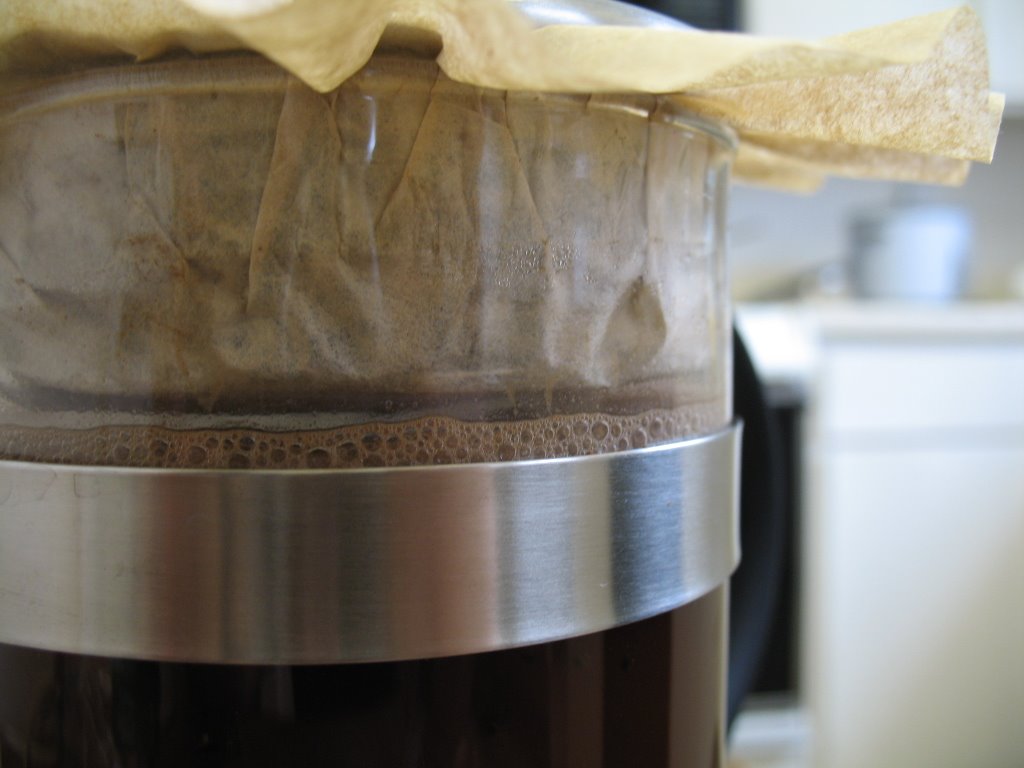
After 2-3 minutes (that's all the time you need) I lift the lid, fold the filter in, and slowly push down, pausing every 20 seconds or so to shake the press a little to scatter the grinds and allow for the easier flow of liquid through the filter. Pushing down too hard or quickly will cause the filter to tear.
I finish with a beaker full of excellent coffee, and pour it out so it doesn't brew further, and enjoy.
The only other thing I would like to get is a manual burr grinder to replace my electric blade whacker. The best burr grinders are made by Zassenhaus in Germany, but they've not exported any grinders to the US for about two years or so, hence they're hard to come by. I've been watching eBay, but every time a decent one is offered, the price ratchets up to $100+. Don't want one that badly. I've heard that blade whackers cause some flavor loss due to heat, but I just want to switch so I can get one less electronic gadget in my life.
Once I get there, I think I could brew some cups that even Thoreau might try, and hopefully he wouldn't exclaim afterwards, as he did in Walden, "Ah, how low I fall when I am tempted by them!"Bad coffee and how it got that way, and how to make it better.
filed under: corporate US, do it differently

